GREENER BUILDINGS & ENERGY EFFICIENCY
“In order to change an existing paradigm you do not struggle to try and change the problematic model. You create a new model and make the old one obsolete.”
Utility bills are rising and climate change is a real contributing factor.
Climate change affects us year-round. Hotter climates mean we use more electricity by turning on more ACs in our buildings and running ACs for longer periods. Furthermore, erratic weather and natural disasters are becoming more common and damaging utility infrastructure, of which costs are passed down to consumers. Since 2021, residential electricity prices have increased by approximately 40 percent, with prices increasing by 7 percent in 2025 alone.
In Jersey City, buildings are the largest source of greenhouse gas emissions. With all the development underway and as Jersey City grows, there is tremendous opportunity for incorporating Green Buildings & Energy Efficiency across Jersey City. By improving energy efficiency and expanding clean energy, we can create a healthier and more equitable city for all.
Emerging Models
In 2024, Local Law 97 went into effect in New York City, placing carbon caps on most buildings larger than 25,000 square feet. The law began phasing in carbon caps for large buildings in 2024, and those limits will become more stringent over a series of compliance periods through 2049. In 2050, all buildings will have to meet zero emissions requirements.
The Effect of Buildings on the Climate
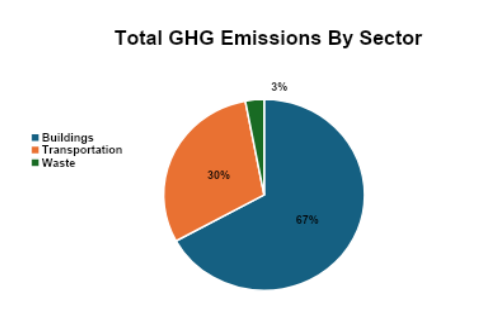
Buildings account for approximately 67% of Jersey City’s community-wide greenhouse gas emissions, more than transportation and waste combined.
Heating, cooling, lighting, and powering our homes, businesses, schools, and institutions generate the majority of these emissions. Emissions come from fossil fuels, either burned directly on-site (like a gas furnace) or consumed indirectly through electricity generated at coal and natural gas plants.
How jersey City can Take Action
-
JC opts in to NJ C-PACE Program
The C-PACE Program provides a new form of financing for renewable energy, energy efficiency, water conservation, and resilience-related improvement across New Jersey.
-
The New Jersey Board of Public Utilities (NJBPU) has issued an Order requiring the owner or operator of every commercial building over 25,000 square feet in the state to benchmark energy and water use.
-
In 2021, the Jersey City Council passed the Jersey City Energy Action Plan to reduce greenhouse gas emissions 80 percent below a 2016 baseline by the year 2050. See below for objectives.
-
NEEP, together with the Rutgers Center for Urban Policy Research, is working with the NJ Board of Public Utilities (BPU) to support the NJ Zero Energy Buildings Roadmap (ZEB Roadmap) and facilitate the New Jersey Energy Code Collaborative (NJ ECC). The goal is to leverage codes as a key strategy to help affordably reach the state’s energy efficiency and GHG emission reduction goals.
Useful Resources to Review
The Institute for Market Transformation - City Energy Project
Energy Efficiency & Energy Conservation – What’s The Difference ?
Green Building Community Presentations SJC Have Hosted: